Why 2026 is a turning point for villa interiors in New Cairo and Sheikh Zayed
Two things have changed in the last eighteen months. First, the supply of compounds delivering at the top end — West Golf, Hacienda West, Sodic Estates, Allegria, Mivida's later phases — has matured, and the clients buying into them are travelled, design-literate and far less interested in showroom-style finishes. Second, the material market in Egypt has caught up: locally sourced limestone, travertine, walnut veneers and serious joinery shops can now hit a standard that previously required full importation.
The result: in 2026, a well-designed villa in Sheikh Zayed or New Cairo no longer has to choose between Egyptian craft and international sensibility. It can be both, and that's the brief we're getting almost every week.
Quiet luxury replaces ornament
Gold trim, glossy lacquered panels, oversized chandeliers as centrepieces — they're out. The vocabulary in 2026 is honed limestone, smoked oak, brushed (not polished) brass, raw linen, hand-troweled plaster. Surfaces are matte. Joinery is full-height and flush. Hardware is small or hidden.
What this actually means at handover: a wall feels like a single material rather than an assembly of mouldings, and a room reads as one composed object rather than a collection of furniture and accents. It's harder to design and harder to build — but it ages better, which is what New Cairo and Sheikh Zayed clients are now optimising for.
A well-designed villa in 2026 reads as one continuous interior — not a collection of accents.
Open-but-zoned plans for Egyptian family life
The fully open American plan never really fit Egyptian life. A formal majlis or reception still matters — for first visits, family gatherings, and the simple privacy of being able to host without exposing the kitchen. But isolating it behind a corridor kills the airy feel modern clients want.
What works in 2026 is open-but-zoned: a single continuous volume for living, dining and kitchen, with the formal majlis treated as a connected but distinct room — separated by a wide cased opening, a pivoting timber screen, or a half-height stone wall. You keep the sightlines, you keep the privacy, and the house reads as generous instead of cavernous.
This is exactly how the West Golf residence was planned — the formal reception, family lounge and double-height entry hall connect as one cinematic sequence without ever collapsing into a single undifferentiated room.
Bedrooms as retreats
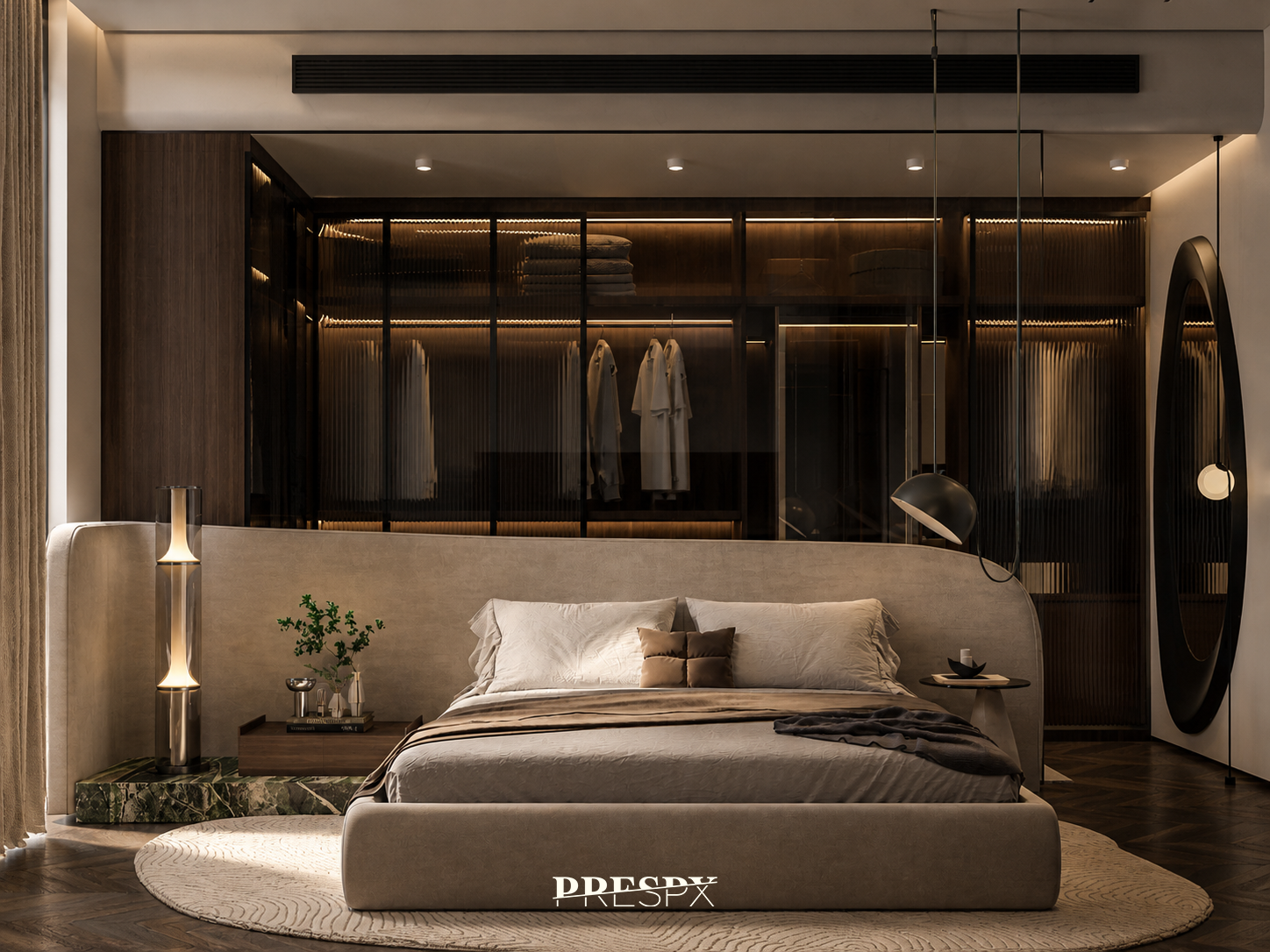
The master suite is where the quiet-luxury vocabulary is most visible. We're specifying curved upholstered headboards in linen or wool, full-height fluted walnut or oak joinery walls, blackout-plus-sheer curtain combinations on motorised tracks, and a layered lighting plan that includes bedside reading sconces, an indirect cove behind the headboard, and a single decorative pendant or grouping.
The dressing room is becoming a true room, not a closet — often behind a wall of fluted glass so it remains part of the suite visually without losing privacy. It's one of the highest-impact upgrades a Sheikh Zayed or New Cairo villa can make for relatively contained cost.
Bathrooms: spa-grade as standard
Full-slab stone walls (not tile), recessed niches lit from above, walk-in showers with a single glass panel, warm metal fittings in brushed bronze or champagne, and a freestanding tub treated as a sculptural object. Floors are usually a softer, honed natural stone — travertine, limestone, or a warm marble — for warmth underfoot.
The detail that separates a good 2026 bathroom from a generic one: the vanity. Wall-hung, full-width, single slab top, undermounted basins, and integrated linear lighting under the mirror that wraps the whole wall. It's the single most photographed room in a finished villa.
Outdoor living and the North Coast crossover
Sheikh Zayed and New Cairo clients almost always own — or are planning — a second home on the North Coast. The vocabulary is now traveling between the two: lime-washed plaster, pale timber, woven textures and a cooler palette designed to handle sea light.
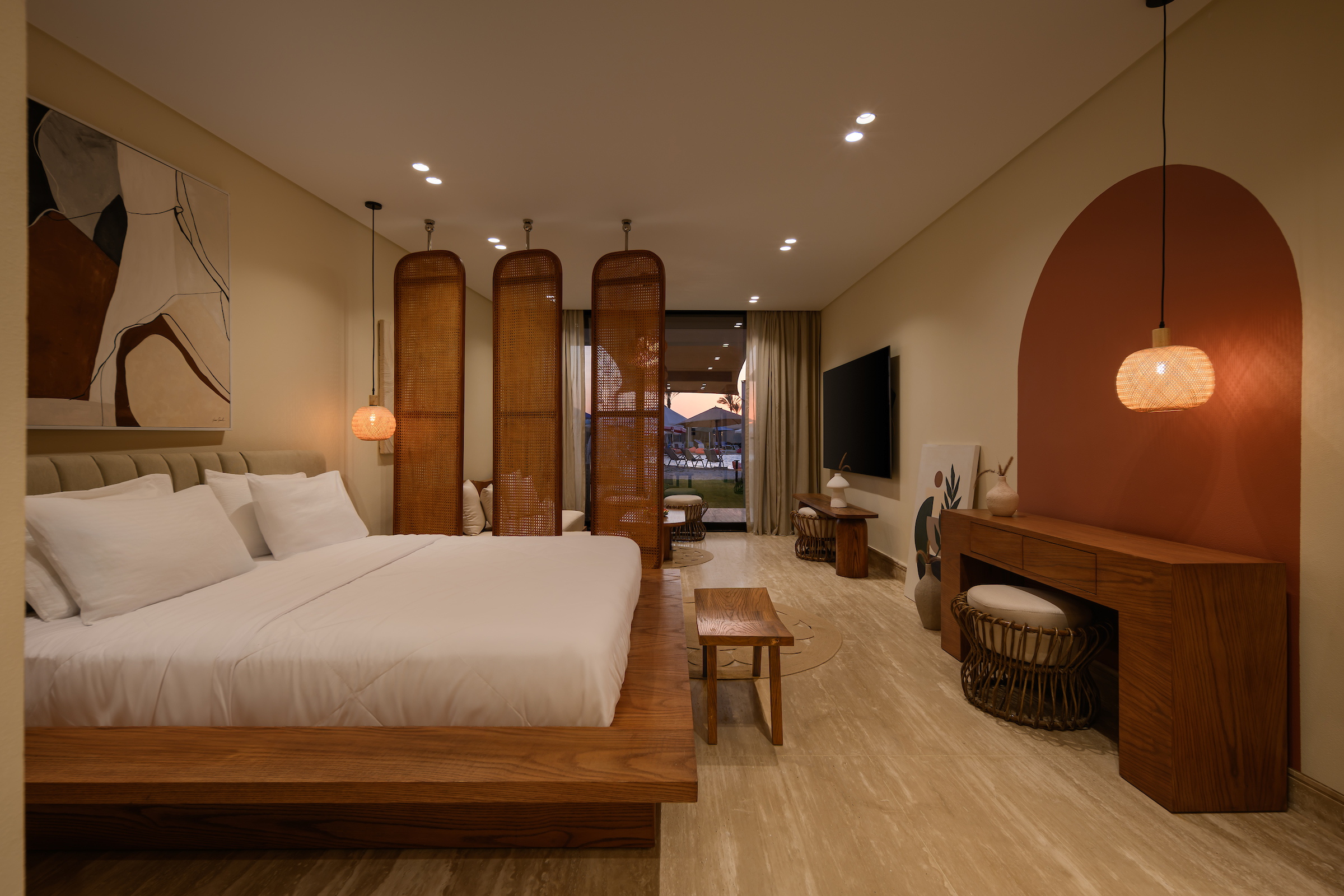
The Hacienda Bay cabin we delivered last season is a good reference for how this language works at the coast — soft whites, oak millwork, sand-toned upholstery — and increasingly we're seeing clients ask for a calmer, lighter zone inside the main Cairo villa that echoes it.
Lighting is the trend
If you only invest in one thing, invest in lighting. A 2026 villa lighting plan separates ambient, task and decorative layers, runs on a single dimming system (KNX or Lutron at the high end), and treats colour temperature as a design decision — 2700K in living spaces, 3000K in kitchens and bathrooms, never mixed within the same line of sight.
Indirect cove lighting along ceiling perimeters, recessed wall-washers behind curtain tracks, and decorative pendants chosen as sculpture rather than fixtures — this is what makes a finished villa feel cinematic at dusk, and it's almost impossible to retrofit cleanly. It has to be drawn in from day one.
Smart home, done quietly
The trend is toward fewer screens, not more. A single in-wall keypad per room controls lighting scenes, curtains and climate. Voice and app are backups, not the primary interface. AV gear lives in a dedicated equipment room, not behind a TV.
What clients regret skipping: motorised curtain tracks, integrated AC zoning, and a proper Wi-Fi access point plan. What they regret installing: oversized touchscreens, gimmick lighting effects, and any system that requires a phone to turn on a light.
What to budget in 2026 — Sheikh Zayed vs New Cairo
Budgets in Egyptian villa fit-out have moved meaningfully in the last two years, driven by imported stone, joinery hardware, lighting control systems and qualified site labour. The numbers below are studio averages for turnkey interior fit-out (design + supply + execution), excluding base construction, structural changes and the cost of the land or shell.
Sheikh Zayed and New Cairo run within a few percent of each other — the larger driver is finish level, joinery complexity and lighting/AV scope, not the postal code.
| Finish level | EGP per sqm | What it includes |
|---|---|---|
| Considered modern | 18,000 – 28,000 | Quality joinery, mid-range stone, layered lighting, FF&E to high-street level. |
| High-end studio standard | 28,000 – 45,000 | Bespoke joinery, full-slab natural stone, KNX/Lutron lighting, designer FF&E. |
| Flagship residence | 45,000 – 75,000+ | Architect-coordinated envelope, bookmatched stone, custom lighting fixtures, integrated AV, imported FF&E. |
How to choose an interior designer in New Cairo or Sheikh Zayed
A short, honest checklist before you sign with any studio in Egypt:
- Ask to see shop drawings — not just renders. Real studios produce plans, elevations, joinery details and lighting layouts. If all you're shown is 3D imagery, the project will struggle on site.
- Confirm who supervises execution. The designer should be on site weekly, with a dedicated technical lead. Sub-contracted supervision is where most New Cairo and Sheikh Zayed projects lose quality.
- Demand a transparent BOQ (bill of quantities) with line-item pricing. Lump-sum quotes hide margins and make change orders painful.
- Visit a completed project. Renders lie about light, scale and finish. A handed-over villa doesn't.
- Check the joinery supply chain. The best Cairo studios work with two or three trusted workshops they've used for years — that relationship is what holds the finish standard together.
Frequently asked questions
- How much does interior design cost for a villa in New Cairo?
- Turnkey villa fit-out in New Cairo in 2026 typically runs EGP 18,000–45,000 per sqm for a considered-to-high-end finish, and EGP 45,000+ for a flagship residence. The figure covers design, joinery, finishes, lighting and FF&E — not base construction or the land.
- How long does a full villa fit-out take in Sheikh Zayed?
- A complete villa fit-out in Sheikh Zayed runs eight to fourteen months from contract to handover, depending on size and complexity. Design and documentation take two to three months, joinery fabrication runs in parallel with site works, and final FF&E install closes the project.
- What's the difference between an interior designer and an interior architect?
- An interior architect resolves the space itself — plans, ceilings, joinery, lighting and finishes drawn as construction documents. An interior decorator selects furniture and styling. A full studio like PRESPX does both, plus on-site supervision, under one contract.
- Do you handle execution, or only design?
- We deliver turnkey. PRESPX produces design, shop drawings, BOQ, joinery supply, site supervision and final styling under a single contract. The same team is accountable from the first sketch to the handover walkthrough.
- Which compounds do you work in across Cairo?
- Across Sheikh Zayed we work in Allegria, Beverly Hills, Westown, Hacienda West, Belle Vie and similar. In New Cairo: West Golf, Mivida, Katameya Heights, Katameya Dunes, Jasmine and Stone Park. We also deliver on the North Coast — Hacienda Bay, Sidi Heneish and Sodic Estates.
- How do I start a project with PRESPX?
- Send the site address, an idea of scope (full villa, single floor, specific rooms) and any plans or photos you have. We respond within seven days with a studio proposal — principal designer, fee structure and timeline. The discovery call is thirty minutes.